close

Satellite MLS powers Curtin University HIVE

World-leading visualisation hub Curtin University HIVE, whose facilities have supported pioneering research in space exploration, health sciences, education and engineering, recently celebrated another milestone: the world’s first installation of Digital Projection’s cutting-edge new Satellite Modular Laser System (MLS) projectors.

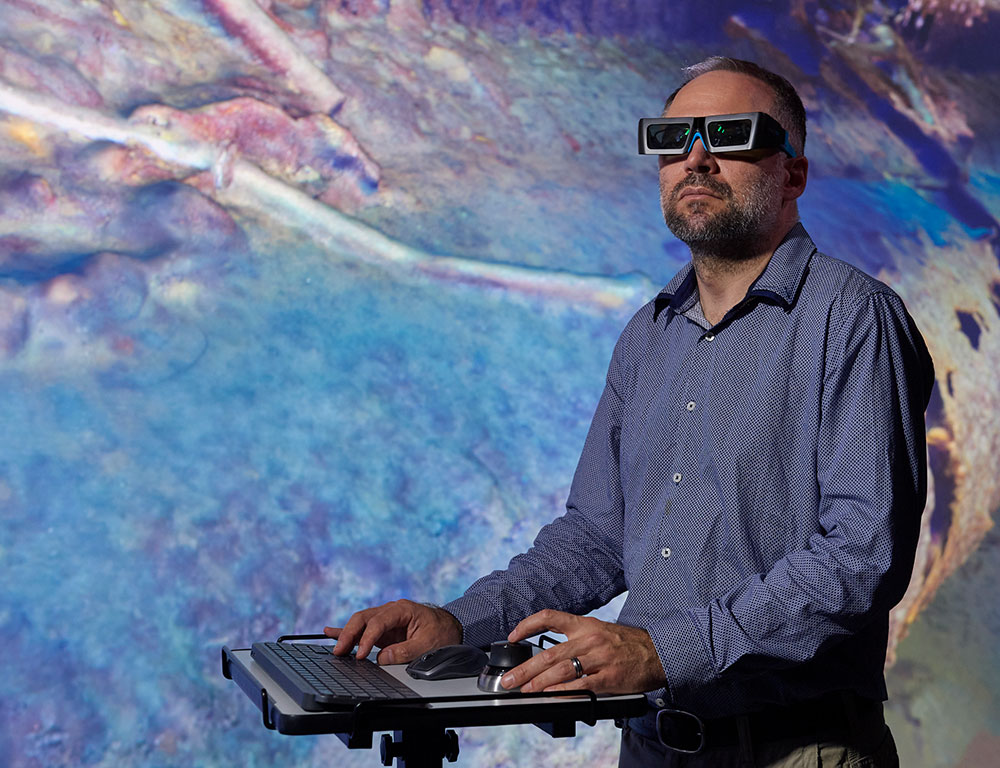
The HIVE (Hub for Immersive Visualisation and eResearch) at Curtin University in Perth, Western Australia, is one of the most advanced visualisation facilities of its kind, and the only one in the world that contains five different large-scale visualisation displays. Its work with technologies such as virtual reality (VR), augmented reality, data and scientific visualisation, photogrammetric 3D reconstruction, and volumetric imaging has been used to, among other things, help patients with spinal cord injuries, investigate consumer behaviour and create virtual experiences of shipwreck sites.

“Essentially, it is a sandbox offering university research staff the opportunity to explore a wide range of visualisation technology options in research projects across all expertise areas,” explains associate professor Andrew Woods, manager of the Curtin HIVE, who also served as the client lead for the upgrade project. “The facility was originally established in 2013, so it was definitely time to update the HIVE AV systems with the latest projection technology,” he adds.
Satellite MLS powers Curtin University HIVE

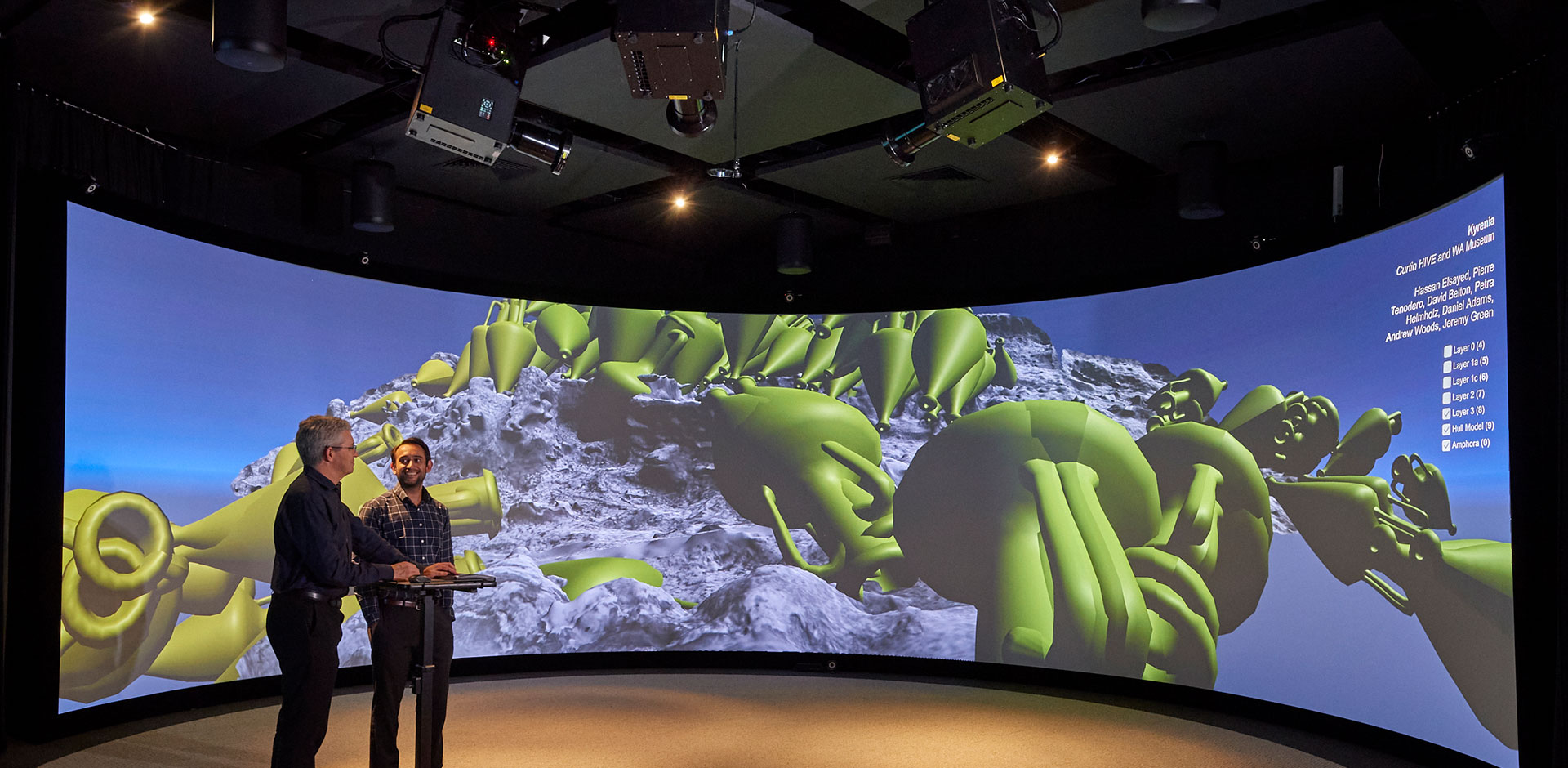
The display facilities at the HIVE, located in a 15m × 15m former gallery space, comprise the Dome display, a 4m-diameter half-dome which fills a user’s primary and peripheral field of view; the Cylinder display, a wrap-around 3D display providing a VR experience for up to 50 users; the Wedge display, a pair of 3.8m diagonal 3D displays used mainly for scientific visualisation; the Tiled display, which with 24MP resolution is used for super high-resolution visuals; and the Hologram Table, which provides two users with 3D visuals that project out of its tabletop display surface. The upgrade project focused on the Dome and the Cylinder displays.

“The HIVE Cylinder display is the flagship system in the facility,” continues Woods. “The Cylinder display uses three projectors to light a 3m-high, 8m-diameter, 180° cylindrical projection screen. In upgrading the HIVE Cylinder display, in particular, we were keen to increase the display resolution to use native 4K projectors, which would provide a four-fold increase in displayed pixels, and to increase the brightness, all while maintaining the existing 120Hz stereoscopic 3D capability of the display.”

After talking to Digital Projection, the team at InDesign Technologies, the project’s consultant, realised quickly that Digital Projection’s Satellite MLS was the only projection system that met the HIVE’s requirements (full 4K with 120Hz compatibility, and not subject to the exclusion zones that would be necessary with a class-3 laser product) – to the extent that Curtin University was willing to wait for it to come to market rather than compromise by specifying a different system.

“The Digital Projection Satellite Modular Laser System (MLS) was still in development as a technology when discussions commenced,” recalls Tanya Hall, business development manager, integrated solutions, for Amber Technology, Digital Projection’s distributor in Australia and New Zealand. Hall worked closely with Woods, InDesign, integrator Vizcom Technologies, and Emilijo Mihatov, regional sales manager for Digital Projection, to discuss and scope the technology requirements of the project, and VIOSO to develop a solution for the unique requirements of the HIVE Cylinder install.

Satellite MLS powers Curtin University HIVE

Launched last summer, the unique Satellite MLS separates the light source from the small, lightweight projector ‘head’, giving integrators greater freedom, particularly where space and access are restricted, while reducing noise and heat from the audience location. This technology makes high-end RGB laser illumination accessible at a cost-effective price point.

At the HIVE, three Satellite MLS systems are installed in the Cylinder display, with a further system deployed in the Dome display. Taking advantage of the Satellite MLS’s modular nature, which allows up to 100m separation between the projection head and light source, InDesign was able to hang the unobtrusive satellite projector heads at the display sites while locating the light sources around 15m away in a server room containing the other AV and computer equipment.

Satellite MLS powers Curtin University HIVE

“There was a requirement for the projectors to make as little noise impact to the space as possible,” explains Scott Wrightson, project manager for Vizcom Technologies. “This made the Digital Projection Satellite MLS systems invaluable. By having the main laser processor housed in the central comms room it made the operating noise level of the projection heads very low, which in turn suited this project perfectly.”

“The Digital Projection Satellite technology allowed us to meet our needs and more, with a small head size, minimised audible noise from the head – because the light source is in the server room – rich laser-light engine visuals, and cinema-quality three-chip DLP® images, at a reasonable budget point,” adds Woods.

Amber Technology worked with, and were supported by, Digital Projection at a very high level throughout the project timeline, say the Amber team. There were many hours of communication with the Digital Projection team to tap into their expertise on the specification, solution scope and system commissioning. In particular, the Digital Projection team’s insight into how the system would interact with the HIVE’s existing infrastructure was invaluable, they add.

Not that it was always plain sailing – working with such a new technology was bound to bring certain challenges. The projectors required specialist lenses that did not, at that time, have any local distribution representation, so with the help of Emilijo Mihatov from Digital Projection, Amber Technology were able to contact the lens manufacturer and establish a trading arrangement to bring the required lenses into Australia for this project.

Similarly, with the sophisticated blending requirements for the cylinder component of the project, Amber were able to make the connection with VIOSO through Digital Projection and source the blending workstations required.

Satellite MLS powers Curtin University HIVE

Physical mounting positions also proved to be an issue, recalls Wrightson, with a full structural reinforcement required to have the mounting beams in the correct positions for both the Cylinder and Dome displays.

“With this mounting solution also came some environmental vibrations form the building’s HVAC systems,” Wrightson continues, “which was particularly noticeable when using the Jenoptik fisheye lens in the Dome display area, so we had to design and construct a custom lens collar to negate this.”

Richard Neale, Amber Technology’s general manager, integrated solutions, comments: “As the distributor for Digital Projection in Australia and New Zealand, we were excited to be involved in the first installation in the world of this new, cutting-edge technology. For Amber Technology, the HIVE is an important first as we introduce the capabilities of the new Digital Projection Satellite MLS system to the broader market in Australia and New Zealand. The HIVE perfectly showcases the possibilities for projection in new and exciting environments.”

“It has truly been a pleasure in seeing this project come to life,” adds Wrightston, “and I hope I get the chance to work closely with the Digital Projection and Amber team again in the future.”

For the HIVE, the improved AV system is an important step forward for a facility whose work revolves around high-impact visuals. “Ultimately our aim is that the displays in the HIVE are essentially invisible to the user, just providing a window into a different world,” explains Woods. “Our aim is to put amazing visuals on the blank canvas of these displays – visuals that support the applications and research projects that our users come to us with.”

The Satellite MLS more than delivers on that aim, he adds: “Digital Projection worked incredibly hard to deliver a new-to-market product for installation into the HIVE, half-way across the world. Despite all the challenges, the systems are now in and working wonderfully.

“The Cylinder and Dome displays also have much more punch than they previously did, creating high-quality experiences for the HIVE’s users and visitors overall. We are very impressed with the result and already wowing people with the quality of the visuals and the university’s leading-edge research.

Satellite MLS powers Curtin University HIVE

Product mentioned in this case study: Satellite MLS

  • Up to 40,000 Lumens
  • Modular RGB laser light sources
  • Compact projection heads
  • 8K, 4K, 4K-UHD & WUXGA Resolutions

Satellite MLS

Satellite Modular Laser System (MLS) offers a small number of simple building blocks that allow users to address a wide range of applications, from single projector installs to complex, multi-channel domes, caves and simulators. Where RGB laser illumination used to be the preserve of only very high-end applications, the Digital Projection Satellite MLS system will make this technology accessible to the wider AV market, at a cost-effective price point.

Find out more

Digital Projection Propels Visitors into the Data-Verse

Known for his incredible artistic works created from raw data and sound, Japanese visual and sound artist Ryoji Ikeda recently presented the final instalment of his spectacular data-verse exhibition series at 180 Studios, 180 The Strand (London, 20th May – 18th September).

The exhibit – which was curated by Fact and The Vinyl Factory – explored Ikeda’s five years of work on the Data-Verse, which investigates through an audio-visual experience the science of the natural world, via vast data sets conducted by NASA and the Human Genome Project, DNA sequences, galactic coordinates and quantum physics. The event marked the first time the entirety of the data-verse trilogy, all 12 artworks, commissioned by the Audemars Piguet Contemporary, were available to view from one location, with the previous data-verse instalments launched in 2019. Audemars Piguet has been a cornerstone partner in the success of Ryoji Ikeda’s Solo Exhibition in London.


Digital Projection Propels Visitors into the Data-Verse

With the exhibition also featuring a number of never seen before installations, it was even more vital that the works were represented effectively. In order to provide the best visually impactful experience, the projectors used for the project needed to be as high quality at possible to replicate the smallest details in the vast data sets within the artwork. For this, 180 The Strand chose to rely on Digital Projection’s INSIGHT 4K projectors.

“Having worked with Ryoji previously at 180 and for Venice Biennale, we were aware that his work requires the very best and most current technology to work with, hence this choice,” said Neil Thomas, Head Of Production at 180 The Strand & London AV. “We previously ran a test of Data-Verse and could see the 4K’s potential, so we knew it was the right decision.”

Delivering a stunning 27,000 lumens of solid-state illumination at a resolution of 4096 x 2160, Digital Projection’s Insight 4K Laser projectors provide four times the resolution of a standard HD projector. The crystal-clear level of detail was a particular advantage for the Ikeda exhibit, ensuring no detail was missed.

“Ryoji and his studio are very autonomous and thorough in their preparation, which leaves me to concentrate on perfecting the build elements he requires for the artwork,” continued Thomas. Suited to a range of installations, the projectors have the capability to project large, detailed images from just one projector, where previously edge blending 2 or more projectors would have been necessary. With 20,000 hours of illumination from the solid-state laser light source, the INSIGHT 4K Laser boasts an unbeatable efficiency and reliability.

The three projectors were mounted in different places across the studio for maximum effect. One was ceiling mounted, while the others were installed into columns built just for the installation. “The weight of the projectors, the height for installation, and the fact we had to have them inverted for the work were all elements we had to consider in the project,” explained Thomas. “This required us to build the projectors their own columns which we disguised as features of the original building.”

The result of the projector choice and installation efforts was an immersive experience that replicated the intensity of the dazzling works in perfect detail, enjoyed by a reported 85,000 visitors over the course of the exhibition. “We’ve had a tremendous reaction to this work, which is the first time it’s been shown on 3 screens at once,” concluded Thomas.

Pictures credit: ©Ryoji Ikeda – data verse, 180 Studios, 2021. Picture Jack Hems
https://www.180thestrand.com/

Digital Projection Propels Visitors into the Data-Verse

Digital Projection brings Deep Fakes exhibition to life with ground-breaking MultiView 3D technology

In addition to the 21 high-tech artworks and virtual experiences on display, visitors to a forward-thinking new exhibition in Switzerland will have front-row seats for another technological first: the combination of Digital Projection’s Satellite MLS system with MultiView 3D projection technology to help reconstruct Michaelsberg Abbey, a 1,000-year-old Benedictine church in the UNESCO world heritage site of Bamberg, Germany.

Deep Fakes: Art and its Double, which runs until April 2022, is turning heads at EPFL Pavilions in Lausanne with a unique showcase of the emerging digital culture disrupting the art world. From artificial intelligence to computer vision, interactive and immersive media to 3D and 5D printing, technology is revolutionising how art is conceived, created and experienced, and Deep Fakes is the first exhibition to deal with this technological transformation at scale and intensity.

The 1,000m² exhibition is “the culmination of several years of new creative practices emerging from the world of computer science,” explains the exhibition’s curator, EPFL Pavilions director Sarah Kenderdine, who has dubbed these new artefacts, which borrow or build upon existing artworks, ‘cultural deep fakes’. “It was only recently that artists and producers began to fully grasp the potential of computational production and new forms of art,” adds Kenderdine, a professor of museology who has more than 20 years’ experience developing and producing large-scale immersive and interactive exhibitions for museums, as well as world heritage sites throughout Asia such as Angkor in Cambodia and, in Europe, Greece’s Olympia.

Digital Projection brings Deep Fakes exhibition to life with ground-breaking MultiView 3D technology

Among the ‘cultural deep fakes’ on exhibit at EPFL Pavilions, located on the campus of the Swiss Federal Institute of Technology of Lausanne (EPFL), are The Next Rembrandt, which uses artificial intelligence to create a ‘new’ work from the Dutch master, who lived and died in the 17th century; The Golden Calf, by seminal media artist Jeffrey Shaw, which reveals itself only when the visitor has circled around its pedestal in a “dance of veneration”; and Abbey Saint Michel, Bamberg, a complete digital reconstruction of the interior of the 1,000-year-old monastery.

The physical Michaelsberg Abbey has been closed for renovations since 2012, when structural damage was discovered. As part of the restoration process, 3D laser scanning specialist ArcTron was commissioned by the city of Bamberg to create a high-resolution, photorealistic recreation of the church’s interior, which contains significant works of late-Renaissance and Rococo art, sculpture and architecture.

For the Deep Fakes exhibition, the Virtual Reality and Visualization Research group at Weimar’s Bauhaus University and spin-off company Consensive developed real-time rendering techniques for ArcTron’s 3D models, allowing them to be presented in immersive VR using Multi-View, Digital Projection’s multi-user 3D projection technology.

The Digital Projection system in Lausanne, which was also installed by Bauhaus University, comprises one INSIGHT Satellite MLS 4K HFR 360 MultiView projector, along with six pairs of Volfoni-made glasses. Using the ultra-fast frame rates (360fps) unique to Multi-View, this single projector is able to provide a true 3D experience to several viewers, each of whom has a view of the exhibit that remains appropriate to their changing position. This allows the users to see and interact with each other in a truly shared collaborative manner.

“Instead of providing 120 frames per second, which is enough only for single-user 3D, the INSIGHT Satellite MLS 4K HFR 360 delivers an unrivalled 360 frames,” confirms Kenderdine, who says the technology is quite simply revolutionary for heritage experts, in that it can provide everyone viewing a digital artwork with a shared experience. “Giving each user a unique perspective on an object provides us with unpredicted ways to collaborate,” she enthuses.

Digital Projection brings Deep Fakes exhibition to life with ground-breaking MultiView 3D technology

In Satellite MLS (Modular Laser System) spec, the INSIGHT Satellite MLS 4K HFR 360 offers museum professionals an even more compelling solution for modern multi-media exhibitions, explains Digital Projection’s Thierry Ollivier, who is leading the company’s involvement in the Deep Fakes project. With Satellite MLS, the small, lightweight projector head is dissociated from the light source, which allows for bright, 4K projection with a compact footprint and minimal noise/heat generation near the exhibits themselves. This unique design, says Ollivier, makes Satellite MLS ideal for theatres and opera houses, historic buildings, and other heat/space-restricted applications.

Technologies such as Multi-View and Satellite MLS will play an increasingly important role in future art and museum exhibitions, where AV will help immerse visitors in ever-more interactive experiences, concludes Kenderdine. “At a museum level, these tools offer new ways to tell stories: stories that are not necessarily didactic, stories that are emerging and responding to user interaction, and stories visitors can embody and inhabit. AV opens up the archive and gives it so much more potential for reuse. It gives artists and creators and curators a new canvas to create aesthetic frameworks we have never seen before, and modalities of engagement which transport and delight visitors”

As for the Digital Projection solution specifically, EPFL Pavilions couldn’t be happier, she adds. “The unit worked like a dream – with remote support from Digital Projection it was up and running in half a day.

“The public also adore it. They recognise the difference; it’s like nothing they have seen before. And the scientists at EPFL have also come for multiple visits to the exhibition, to see the new opportunities presented by the technologies.”

“Working with Professor Kenderdine for the last ten years on projects involving projection and virtual reality, I applaud her talent and efforts to bridge the gap between technology and art,” adds Ollivier. “With Deep Fakes, by combining expertise from Digital Projection, Consensive and Volfoni, Sarah and her team have demonstrated to a wide range of audiences, from world-leading cultural authorities to local students, what a virtual reality experience should be like. Seeing is believing.”

Digital Projection brings Deep Fakes exhibition to life with ground-breaking MultiView 3D technology

Product mentioned in this case study: Satellite MLS

  • Up to 40,000 Lumens
  • Modular RGB laser light sources
  • Compact projection heads
  • 8K, 4K, 4K-UHD & WUXGA Resolutions

Satellite MLS

Satellite Modular Laser System (MLS) offers a small number of simple building blocks that allow users to address a wide range of applications, from single projector installs to complex, multi-channel domes, caves and simulators. Where RGB laser illumination used to be the preserve of only very high-end applications, the Digital Projection Satellite MLS system will make this technology accessible to the wider AV market, at a cost-effective price point.

Find out more

サポート

完全な安心感とシームレスな視覚体験のために、Digital Projectionを信頼してください。

Cog Icon

Japan Technical support

jp.dp@deltaww.com

03-5733-1271

Cog Icon

USA Technical support

Techsupport@digitalprojection.com

770-420-1350

Cog Icon

Europe Technical Support:

Service@digitalprojection.co.uk

+44 (0) 161 947 3353

日本
デルタ電子株式会社
〒105-0012
東京都港区芝大門2-1-14


Cog Icon

お問い合わせ

電話番号: 03-5733-1271

メールアドレス:jp.dp@deltaww.com

Send us a message

By submitting this form you agree to Digital Projection storing your data for the purposes of responding to your enquiry.